Pages

23 November 2022

HSM 2022 #7: "Reverse Revers" pockets

Pockets with "revers".

Intrigued by a pair of late 18th century French pockets of an unusual model, that narrowed at the top even though there weren't any side seams or pleats, I searched for photos of other pockets that might explain what they looked like underneath the trim.

29 October 2022

HSM 2022 #2: "Third Hem's the Charm" neckerchief

My completed neckerchief.

A quick and easy project, for a necessary period accessory. I've stitched one before, with a rolled hem that turned out really ugly. This time I decided to do my research first, to get it right.

18 March 2022

Duran Textiles: new silk ribbons

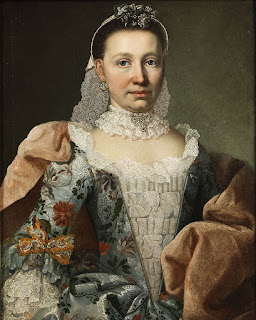
Duran Textiles, the Swedish company producing historical fabric reproductions, has redesigned their website. They're introducing an entirely new range of 5.5 cm (2-1/8") wide silk ribbons with pretty flower designs, at about – gulp – SEK600 (EUR60) per meter ($55/yd). They don't say outright which products are new, but I think there are a few new cotton prints too. 

Portrait of a Lady, Anton Raphael Mengs workshop
"Portrait of a Lady", with flower pattern ribbons,
from Anton Raphael Mengs' workshop
(public domain, {{PD-US}} ). Source: Wikipedia .

13 August 2021

Blue linen at Ikea

Ikea's "Aina" linen in blue-grey

 We visited Ikea today (we're fully vaccinated, but still very cautious, and do most of our shopping online), and I was delighted to see that their linen fabric now comes in a nice shade of blue as well as the white and natural they've carried for a long time (there are also a couple of other colors, that are less useful for historical sewing). 

It instantly made me think of the extant 18th century blue pocket hoops and panniers in Sweden and Germany, so of course I had to buy some for future needs!

Ikea's linen is 150 cm (59") wide and has 15 warps and 11 wefts per cm (about 38 warps and 28 wefts per inch).

02 September 2018

HSM 2018 #8: The trimmed underpetticoat

My project is inspired by a petticoat in the collections of the Chester County Historical Society, depicted and patterned in Sharon Burnston's book "Fitting & Proper".

A partridge petticoat in a pear plum tree.

29 June 2018

In Germany, tailors made women's clothes

For a long time, tailors made outer clothes for both men and women, while female seamstresses and home sewers made linen undergarments. Then in late 17th century France and Britain, female couturières and mantua makers got the right to sew mantuas and other women's clothes. The tailors continued to make stays, stiff-bodied court gowns, and riding habits for women, in addition to menswear.

Similar changes took place in Germany and Sweden too, but the tailors there hung on much longer to the privilege to make women's clothes, so the transition from tailors to dressmakers was delayed for a century or more. In the meantime, tailors in the German tradition continued to develop cutting methods for women's clothes as well as men's; J.S. Bernhardt's two-volume book from 1810‒1811 is the earliest and the most well-known printed example. Sewing techniques also differ between extant garments, depending on if they've been made in a tailor's or dressmaker's tradition. 

16 June 2018

HSM 2018 #3: A frumpy Swedish bedgown

My bedgown, folded in half along the center back.
There are several scaled-down patterns based on extant Swedish bedgowns. Some of them are in the popular book "Kvinnligt mode under två sekel" which can be found in many Swedish libraries, and there are a couple of free patterns online in Duran Textiles' newsletters (here and here).

In spite of this, I chose to spend $30 on a full-scale pattern, that is 15 years old to boot…

08 May 2018

New "18th C" Ikea duvet cover—"Hässleklocka"

"Hässleklocka" duvet cover (photo: Ikea)
This duvet cover is in Ikeas mid price range, and has a slightly higher thread count than the discontinued "Ljusöga" duvet cover. It has 18th century potential, and was probably inspired by period fabrics (if it was more of a reproduction, I think Ikea's website would say so, like for the "Sprängö" duvet cover).

Edit: It's nice to see a print in just red/pink tones for a change—though as usual, the shades are a bit different from period print. 18th century block prints often did incorporate a lighter and darker shade of red.

29 March 2018

Ikea discontinues "Ljusöga" duvet covers

"Ljusöga" duvet cover (photo: Ikea)
Ikea is piloting a website redesign on their Swedish site, with a special section listing products that will soon be discontinued. The "Ljusöga" duvet covers are on that list.

This design has been somewhat popular as an affordable fabric option for late 18th century style gowns, and some examples can be seen at 18th Century Notebook: Ikea Dresses. It is also used in the 1780s Italian gown featured on the cover of "The American Duchess Guide to 18th Century Dressmaking". If you've planned to pick up one of these duvet covers, do so now before they're gone!

On a more positive note, Ikea will soon launch a new 18th century print.

10 March 2018

HSM 2018 #2: The Amazing Garsault Stays


My Garsault stays, worn over a working class shift and an
under-petticoat from a 1990s Ikea fabric based on an 18th
century print (sadly not in the authentic red/black colorway).
There are four amazing things about these stays:
  • They fit me.
  • They're done.
  • I think it's a clever cut.
  • The cut comes from a well-known book of the period—but has gone unnoticed in the costuming world anyway!

There are also some not at all amazing aspects, mostly because I've been cutting corners:

31 January 2018

How to zigzag linen for prewashing

I use to preshrink fabrics before cutting and sewing, but I've always had trouble with linen fabrics which tend to fray in the washing machine even though I've zigzaged the edge. Recently I came up with a better way of zigzaging these tricky fabrics.

15 January 2018

Book review: The American Duchess Guide to 18th Century Dressmaking

"The American Duchess Guide to18th Century
Dressmaking", by Lauren Stowell and Abby Cox
Yay—I got "The American Duchess Guide to 18th Century Dressmaking" for Christmas. :) It provides a wealth of information on how to hand sew British-influenced fashion. As I'm living in a different cultural sphere, I wanted to see to what extent this book's patterns are applicable in countries that were mainly influenced by French fashion.

I'm especially interested in how women's clothes were cut in the 18th century, and as I haven't seen any reviews that have focused on that aspect, I'm also going to share my thoughts on how the book's patterns compare to patterns from extant gowns.

03 January 2018

Vive la différence!

One of the things that fascinate me about period fashion, is the range of variation. Styles didn't just change over time—they varied subtly from country to country (or region to region), as well as across the social scale, and between everyday clothing and Sunday best. There were multiple reasons for this, including tradition, economy, climate, and legislation.

I'll be using the 'vive la différence!' tag to highlight such differences. Kudos to organizations that encourage people to research local clothing!


13 December 2017

HSM 2017 #12: 'Parisian pearls' necklace

how to thread a 17th/18th style faux pearl necklace
my necklace
18th century ladies are occasionally portraited wearing pearl necklaces, often with quite large pearls which were probably fakes. The necklaces were tied with ribbons, the bow is occasionally visible in portraits. They're mainly documented for wear with the early mantua, and later with the robe à la francaise.

Pearl necklaces are quick and easy to make, as an alternative to the puffed ribbon necklaces often seen in the mid-18th century. They make a nice accent in an outfit or for accessorizing a period dressing scene.

20 November 2017

Continental stays 2: The Garsault stays pattern

image from Garsault showing multiple views of stays pattern
M. de Garsault, Art du Tailleur
(1769), plate 12 (detail).
Source: gallica.bnf.fr / BnF.
The stays in Garsault's 1769 "Art du Tailleur" are of a very different cut compared to Diderot's 1771 pattern. Garsault's cut has a more comfortable fit in the lower back, and can be adjusted to improve bust support.

Garsault doesn't depict individual pattern pieces, but we can use his illustrations and written information to alter another pattern into his cut.

06 October 2017

Continental stays 1: Diderot à la Waugh

Waugh's Diderot stays pattern
Waugh's pattern in
Corsets and Crinolines, page 40.
Norah Waugh's classic book Corsets and Crinolines (1954, reprinted 1987) includes her "Pattern of stays from Diderot's L'Encyclopédie".

Comparing Diderot's plates to Waugh's pattern, I found that she'd not just resized it for real bodies, but also taken some liberties in redesigning the stays. Here, I'll describe some changes she made, and how they can be reversed for a more period accurate cut.

28 September 2017

(Pre-)shrinking linen

Some fabric dealers say their linen will shrink up to 10-15 % over the first few washes. Now, most extant linen garments have probably been washed several times, so if we use their precise measurements to sew an exact copy from unwashed linen, we'll end up with an item that will be smaller than the original once it's been washed—and probably disproportionate too, as fabrics shrink mostly in the warp direction. Did linen always shrink this much?
 

04 September 2017

Measuring linen

In the Western world today, we think in centimeters or inches. For sewing projects that don't involve fitting, it's easy to think in round numbers; perhaps different ones depending on if we prefer metrics or Imperial units. But European women in the 18th century and earlier probably picked other 'round numbers' than we do now.

27 June 2017

HSM 2017 #6: 'Metal' bobbin lace

My 'silver' lace, 2 cm (3/4") wide
Traditional metal bobbin lace is made from metal thread, which consists of a thin metal strip wrapped around silk thread. Today's 'metal' thread is wrapped with metallized plastic instead. (Experimental bobbin lace today sometimes uses solid metal wires, which is a completely different thing).

Metal lace is relatively coarse compared to linen lace, and typically uses simpler, non-figurative, designs. Heather Toomer explains in "Antique Lace" (2001) that the stiffness of the metal threads makes them unsuitable for complicated designs (page 119). Still, styles changed over time, just as for other lace.

12 June 2017

My fabric find of the year!

Close-up of today's find
Whenever I pass by my local thrift shop, I check out their fabric section. It's by no means a steady supply of fabrics for historical clothing, but considering how little I sew that's probably just as well. I've found vintage linen yardage there a couple of times, and today I found some really interesting fabric.

It's a pair of vintage window drapes, in a fabric imitating mid-18th century brocaded silk. All in all, I got 5 m (5.5 yd) of 110 cm (44") wide fabric for SEK525 ($55). Not super cheap, but a reasonable price for period appropriate fabric of a very unusual type. I'm especially impressed that they've even copied the use of a solid colored damask patterned ground, as seen in some period silks.